Tuesday, September 4, 2012

A less than formal introduction (ENGL 338)

Yes, I do own this tie. Yes, I look awesome in it.

My name is Alan Hoffmann. This is my second go-around for college. I graduated from Southern Illinois University (go Salukis) with a journalism and radio-television news degree. The idea was to use said degree to cover sports for a living. The reality was, I got to attend lots of really, really boring meetings. "My job is to go to public meetings and get bored so the public doesn't have to," I joked.

In between my two radio jobs, I lived at home. I even, just to be as cliche as possible, set up my computer in my parents' basement. I did complete National Novel Writing Month that November, but the best thing I did while hunting for my next job was to be a volunteer cross country coach. I called the head coach before the season started and asked if I could help out. He said yes. Simple as that I became a cross country coach. It was about three weeks into this that I noticed that I really enjoyed being out there. Not just the running aspect (which was also fun) but interacting with the kids, teaching them, seeing them develop their running skills, watching them interact. It was at about this time that another friend of mine (who was coaching football while looking for jobs) and I decided that we needed to do this for a living. We had to teach. Even though both of our fathers (maybe because both of our fathers) were teachers, we never considered the idea. Well, career choice #1 didn't work, but here was something exciting. 

Well, just as I was about to enroll somewhere and work on an English ed degree, I got my second radio job. So, off to Havre I went. I moved there in the winter and the temperature did not get above freezing for a month. I once called a 19-degree day, "nice". The next winter it got to be 40-below. Lest you think it was all bad, I did meet my wife while living there, so there's that. At any rate, I got tired of covering boring meetings and as soon as I was able to get in-state tuition, I moved to Bozeman and enrolled at Montana State. I'm the fifth family member to go to school here, which is more or less why I chose MSU. 

A few other fun facts....

~My wife and I got married this summer in what I called "the longest, shortest day of my life". Seriously, it is exhausting getting married, but it was a blast. Kodi is beautiful, smart and awesome and I couldn't be going to school and work without her.

~I work the night shift at the C'mon Inn. In a related story, caffeine is great.

~I'm a huge Seattle sports fan (well, not UW. They're evil, as I root for Washington State. My sister went to WSU, Go Cougs!) and against better judgement am a diehard Seahawks fan. That team will be the death of me.

~I love to read and write (an English major with those hobbies?). I really like science fiction and fantasy. As for the writing side of things, I do have two unfinished novels (both National Novel Writing Month efforts. I got to 50,000 words but not the end of the story). I have a tentative deadline of "Someday" to finish them.

~I also like to run and I'd like to coach cross country and track when I become a teacher. 

~I spent a semester of College Part One in Australia and it was one of the greatest experiences of my life. Seriously, if you get a chance to study abroad DO IT. Also, I sometimes slip into Aussie speak and will refer to people as "mate" and say "no worries". I will even refer to things as "dodgey" at times. 

~There were some perks to working as a reporter. I've met 4 U.S. Senators and a handful of U.S. Representatives. That was fun. One time, I called Brian Schweitzer's office for a quote from one of his press people and they said they'd just have the governor call me. Considering my last job was in Illinois, having the governor call me back was really cool. (Ironically enough, the most boring part of the job was school board meetings. Those are the worst.)

I think that's about it. Any questions, just leave 'em in the comments. Or talk to me in person, though a warning: I'll talk your ear off if you give me the chance.

I'll be educated well
Learn about delicacy
I'll be wearing pin-striped suits that say
"Renaissance is me"

Alan

(I will occasionally do lyrical sign-offs)


Thursday, August 30, 2012

Language in Mark Twain's True Story (ENGL 338)

The first thing that stands out in this short story is how language is used to illustrate class. We don't know much about the narrator, but we can assume he is white and privileged to some extent. In a way, Twain also masks where the narrator lives as his few lines of dialect do not have any accent to them. "Why, I thought—that is, I meant—why, you can't have had any trouble. I've never heard you sigh, and never seen your eye when there wasn't a laugh in it." Compare this to Aunt Rachel, whose words are often misspelled and punctuated in such a way that makes her accent come alive even through written word. "Has I had any trouble? Misto C—, I's gwyne to tell you, den I leave it to you. I was bawn down 'mongst de slaves; I knows all 'bout slavery, 'case I ben one of 'em my own se'f." The second sentence there indicates a lack of formal education (or else she might have said I am going to tell you, and then I'll leave it to you.") Given her background (a former slave) we can use these contextual clues to key in on the character of Aunt Rachel, but the language and how it is written allows that to come alive that much more. It should be noted that her words aren't necessarily wrong. Aunt Rachel does communicate effectively, but how she speaks does give us more insight as to her background, especially when compared to the narrator.

Tuesday, August 28, 2012

I think: What English teachers should be teaching (ENGL 338)

(Note: Since I originally set this blog up to chronicle my journey to get an English Education Degree, I figure I could just incorporate a required class blog into this existing one. If you're new here, feel free to read my previous posts. They're mostly just book reviews.)

I've often asked myself what I want to teach when I get a classroom (a science fiction genres course if I could swing it, if you're curious. Read my book reviews, you'll notice a trend in what I read!), but rarely have I asked myself what I should teach. I think ideally what an English teacher should teach can be broken down into a few groups: basics, creativity, and exploration.

The basics are things such as grammar. Knowing how to write and speak correctly is an important skill. I think students should know how the parts of speech operate, how punctuation works, and how everything connects together. Taking a grammar course last year, I liked learning about how English works (sometimes in its own special way). Beyond that, knowing the basics gives students the tools they need to take on bigger and more complex ideas.

Creativity is letting students (as much as you can, anyway) find things that interest them. Reading is a great way to learn more about the world and one's interests, and I think that as English teachers it would be alright to embrace our students' interests and let them find stories and books to read that they'll engage in. I think that would make it all the more likely that a student picks up valuable reading skills. In addition, I think having freedom to write is another great way to shape skills. This is not to say we shouldn't teach some stuff universally (for example, I feel Romeo and Juliet should be taught to everyone. Some stories are so engrained in our cultures, that its important to look at where it originated from. Once could argue that such teachings could be listed under "the basics"), but giving students some control over what they read and write about could have benefits.

And finally exploration. One thing we talked about in class today was the differences in English in different parts of the world and country. I think exploring these differences and looking at how language works around the globe can open up the world of language to a student. Teaching students about regional dialects would also expose them to a kind of diversity that is often overlooked. You can also look at different writing styles and see what the style can tell you about the time and place of the writing. I think its neat to look at how English has changed even from the 1800s (the Journals of Lewis and Clark, for instance) to now.

Saturday, August 11, 2012

I read: Roadside Picnic

Are you ready for some rapid fire book reviews? Because while I have been reading this summer, I haven't been writting about it. So, here's the first of three book reviews: Roadside Picnic. Roadside Picnic is a Russian science fiction novel by Arkandy and Boris Strugastky. I came across the book through the absolutely awesome blog, io9 and the concept seemed like an interesting one. Aliens have come, they left without saying anything, and now in order to figure it all out, people go (often illegally) into the zones where they landed and take stuff out. A point is made in the introduction of my copy that in most sci-fi novels with an alien encounter, it is the result of something heroic. Our brilliant scientists have communicated with them. Our brave soldiers have fended them off. Our wise president has negotiated an agreement with them. But, what if they just came and left? The thing that the story does that I really enjoy (and is also pointed out in the introduction) is it looks at how this event, a global event, one of the biggest events in human history, impacts a commonor. The main character, Red, takes advantage of the situation by being a stalker (someone who enters the zone illegally and sells artifacts on the blackmarket)as well as working for a scientific agency devoted to the zone. He's not a scientist, really just someone who goes in and out of the zone. Through his eyes, we see how the visit has impacted other parts of society: there are abandoned cottages, the scientific inquiry into the area leads to a slight population boon (though in other parts of the world, no one is allowed near the zones for quite some distance). The story focuses on Red and his day to day life, inserting speculation on the visit and commentary on things happening elsewhere are sprinkled in from time to time. Seeing through Red's struggles and triumphs makes his wish of "happiness for everybody, free, and no one will go away unsatisfied" all the more enduring. This was my first time reading anything Russain, and it was very enjoyable. I thought the ending was beautiful. But would I reccomend it to a high school student? Possibly. The version I bought has an afterword from the authors detailing why it took eight years to get the novel published. Soviet censors had no qualms with the subject of the book, or its message, but rather the swearing and questionable actions by the heroes. As a teacher, I would have nothing wrong with a book with heroes that do questionable things (I do love Breaking Bad, for instance) but the swearing might put this book out of my comfort zone for teaching it. I personally am not opposed, but for job security sake I'm not sure this one would make my bookshelf when I get a classroom. Though, would I reccomend it to a mature student? Absolutely. Next up (tomorrow, maybe!) The Postmortal

Sunday, May 20, 2012

I read: The Rook

I was reading The Rook on a visit home, and my Dad asked what I was reading.

"The Rook," I replied. "Its fantasy...and weird."

He laughed, saying something to the effect that most fantasy is weird.

I suppose he's right. It is, after all, fantasy. The genre is not necessarily bound by the norm. My favorite fantasy series, Game of Thrones is fairly down to earth, you know once you set aside the freakishly long winters, dragons, white walkers, people coming back from the dead, and the ability that some characters have to jump into the consciousness of animals. Other than that though, it reads like historical fiction.

The Rook though is WEIRD. It centers around Myfanwy Thomas, a woman who has lost her memory who happens to be a high ranking official in a secret government organization that deals with the super-natural. When I found it on Amazon, I thought The Rook sounded like "The Bourne Trilogy meets the X-Files" and was intrigued.

The thing that threw me off a bit though was the book is, or tries at least, to be funny. At times, Daniel O'Malley reminded me of Douglas Adams. Not that this is a bad thing (Adams is one of my favorite authors) but, it wasn't expected. If I knew that The Rook was going to be as light as it was, I may have found it more enjoyable. There are times when the characters seem so nonchalant about their situtation that it can be very frustrating. "They seem to be taking this Belgian invasion of Britain kind of lightly," you might say while reading this book. In one particular maddening point, Myfanwy decides that, in the face of this impending invasion and trying to figure out why she has lost her memory that she'll reconnect with her long-lost sister by going clubbing.

This may have been the case of expectations clashing with reality. What I expected from The Rook is not what I got. This isn't to say it isn't enjoyable or there's a good story in it. Its just that the story sometimes doesn't take itself seriously. I don't know if O'Malley was striving for supernatural thriller or something akin to Hitchhiker's Guide to the Galaxy, but combining the two didn't work for me. That said, I feel that O'Malley could pull off either style should he commit to one or the other.

Tuesday, May 8, 2012

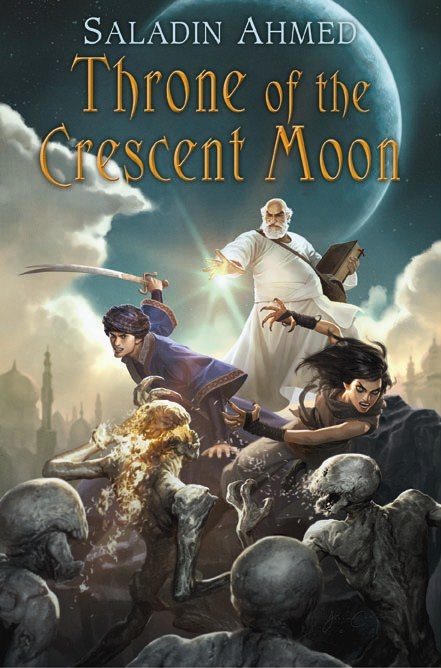
I Read: Throne of the Crescent Moon

Oh, so glad it is summer and I can read what I want! I was able to finally read something that I downloaded to my Kindle in February, and Throne of the Crescent Moon provided me with an awesome escape for a few days.

I don't know if it would be fair to say "With great power comes great responsibility" is a theme in all fantasy novels, but it is a theme that keeps coming up. Throne of the Crescent Moon is no exception. In the novel, a lot of people have power. It could be political power, such as the Kalif or the Falcon Prince hold or it could be magical power like Abdoulla the ghul hunter and his companions hold. What these characters do with that power is telling.

Right from the start, its established that Abdoulla is aging and maybe not up to the task of killing ghouls as he once was. But, time and time again he talks himself into doing it because 1) someone has to and 2) there aren't many left like him that can dispatch ghouls. I think this contrasts neatly with the Kalif and the royal family who, while not getting a lot of time on the page, are referred to often usually along the lines of "the Kalif's doctors could have saved the child..." In fact the whole motivation for The Falcon Prince boils down to what he would do with the Kalif's power, power that is known and unknown.

For that serious of a tone though, the book does offer some really fun moments. After all, this is a place where the spells are cast to make the palace smell nice (and, consequently, route unpleasant smells through other parts of the city). It has a character that can turn into a lioness. Abdoulla cracks jokes all the time. There's a lot of fun to the story.

There are some things that get kind of repetative throughout the novel though. About halfway through, you might say something like, "I get it, Abdoulla is old," or "I get it, Raseed is conflicted,". Raseed might be the most frustrating character in the book. He's very religiously devout at the age of 15, and despite following Abdoullah around for some time never seems to loosen up. I think he takes himself too seriously and feels that even at his young age, he should know all the answers. I suppose this is how a lot of teenagers feel though. The world makes sense to them, and why does the world keep throwing these change-ups at me?

As far as world building goes, the story is fairly localized but the map at the beginning of the novel hints that there might be a larger story to tell. Indeed, this is the first novel in a trilogy, and I'll be looking forward to the next offering by Saladin Ahmed. The stakes seem fairly high in book 1 and I can't wait to see how they're raised in the second act.

Saturday, March 17, 2012

How do I cite this?: E-readers

I might make this a running feature. After all, nothing says "exciting blogging" like how to cite random things. But, in this one instance I think it is important to have a discussion about how to cite something because frankly, there's not a lot out there on the subject.

How do I cite e-readers?

Let me start by saying that I love my Kindle. Instant access to books for cheaper? Yes please. I wish I had more time to read more things on the Kindle. I sort of jokingly kept asking my fiance if she got me one for Christmas and then, because she is awesome, she did so. I've been in love ever since (with the Kindle, love with fiance already established).

One of the things that I really like about the Kindle is that old books are cheap. Sometimes they're free. I know some of the first books I downloaded were Treasure Island and The Art of War. I downloaded them because they are famous books and the latter I've been meaning to read. I also downloaded them because they were free.

For my Classical Foundations of Literature class, I am writing a paper on the political themes within the comedies of Aristophanes. Wanting all eleven of his surviving plays, I went online and sure enough, Kindle delivered.  For 95 cents, I had all eleven plays (I later found that I could have ordered Volume 1 and 2 separately and saved the 95 cents, but oh well.)

So, I read all eleven plays, laughed a bit, highlighted key passages and got set to write my paper until I thought of something. How do I cite this?

There are no page numbers on the Kindle. So, if I cite a passage (which I will undoubtedly do), I have no frame of reference. My usual go-to place for how to cite anything, the Purdue OWL can tell me how to cite a tweet, but has nothing on e-readers.

The best solution I can come up with is that the Kindle does have "locations", which are like page numbers. They are smaller though (my last highlight comes from Location 8,009) which makes it a bit tedious, but I think it will work. I think a note in my works cited page will be in order just to clarify what is going on.

It is tricky because its something that Academia simply hasn't caught up to yet. This surprises me, considering that libraries have been lending out e-books since 1998, so we've had over a decade to figure it out. And I don't think e-readers are going away and will be making bigger strides into education soon. I personally prefer a hard copy if its for a class (will probably do a post on this later), but may try and go the e-reader route in order to lessen my cost and physical burden when buying books next semester (18 pounds of reading!).

What do my readers think? How do e-readers fit into education? How should they be cited? Any other problems you foresee with tech and education merging?